A frontier AI model proved that my research problem is NP-hard. I did everything else: the formulation, the experiments, the statistics and the checking. This is the story behind our IEEE TENCON 2026 paper, written by A. D. A. Siregar and supervised by K. M. Lhaksmana and I. Palupi.
On October 6, 2026, OpenAI put 722 AI-written maths manuscripts on GitHub. They came from an internal model the public can't use. Many mathematicians read it as a sign that the proof itself is no longer the scarce part of mathematics. Others pushed back right away. Tristan Buckmaster (NYU) doubted the results had been properly checked. Andrew Sutherland (MIT) said they should count as unverified until others can reproduce them.
I'm a student researcher at Telkom University. This year I used a frontier AI model, Claude Opus 4.8, on a real mathematical problem, and the resulting paper was accepted at IEEE TENCON 2026. So I've seen a small, everyday version of this debate up close. This post covers what I gave the AI, what I kept for myself, and why I think the second list is the one that matters.
Camera traps record far more wildlife footage than ecologists can watch. Video Large Language Models can reason over that footage, but they need tens of gigabytes of GPU memory. Field stations have nothing like that.
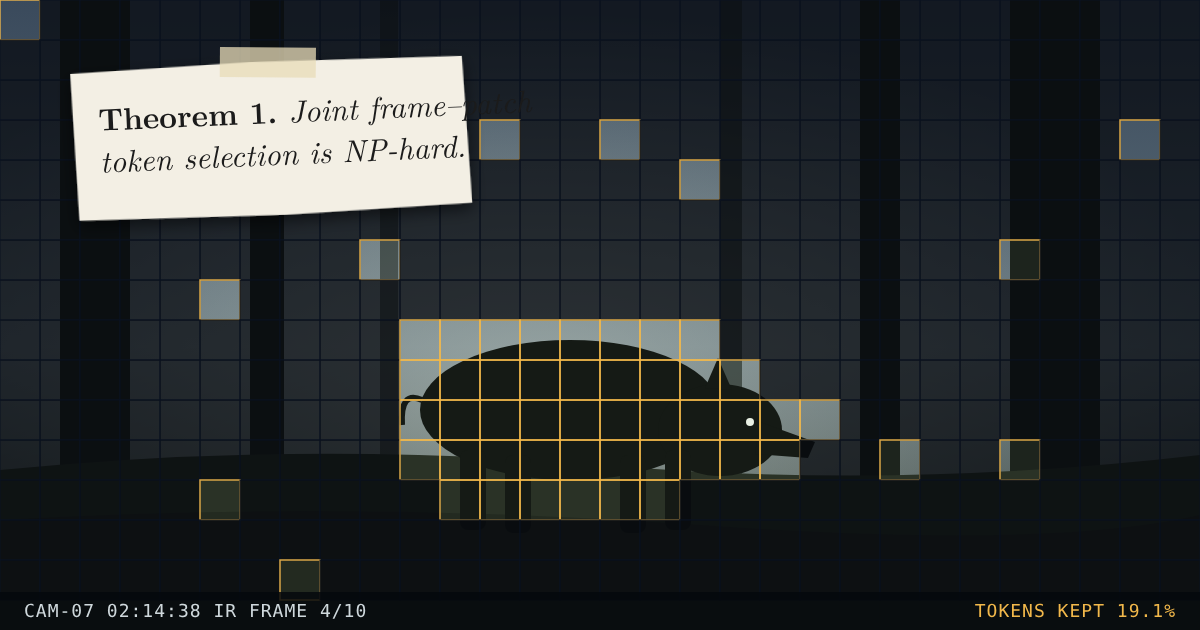
The numbers make it concrete. A single 10-frame trigger burst, cut into patches by LLaVA-1.5-7B's vision encoder, becomes 5,760 visual tokens. That's too many for a 16 GB Tesla T4, the kind of GPU you might actually deploy. The full model runs out of memory before producing an answer.
So the question I set myself was this: if the model is frozen and we can't retrain it, which frames and which image patches should we keep? We want to keep species recognition accurate, keep day-versus-night behaviour detection accurate, and fit inside 16 GB.
I wrote that down as a binary optimisation problem. Each candidate solution is a string of bits: one bit per frame (keep or drop) and one bit per spatial patch position. There are three objectives (species mAP, behavioural F1, token count) and one hard memory constraint. That's 586 bits per clip, so 2^586 possible choices. Nobody is checking those one by one.
I had the formulation, and I had an intuition: this problem is hard in the formal, computational sense. Showing that properly means proving it is NP-hard. That's the job I gave to the AI, specifically Anthropic's Claude Opus 4.8 on its High effort setting.
I gave it my formulation and asked for a proof. It came back with a reduction from Maximum k-Coverage, a classic NP-hard problem. Think of each frame as covering a set of discriminative image patches. Picking at most k frames so the most informative patches are covered is then Max k-Coverage under another name. My joint frame-and-patch problem contains that one as a special case, so it is at least as hard.
The argument became Theorem 1 of the paper:
Joint frame–patch token selection is NP-hard, even when restricted to species mAP alone.
— Theorem 1, Gradient-Free Token Eviction for Edge-Deployable Video-LLMs in Ecological Monitoring (IEEE TENCON 2026)
The AI took the question "is my problem hard?" and returned a reduction I could read, check and defend in front of reviewers. That's a real contribution, and I'm saying so plainly.
The theorem decided what kind of paper this was. If the problem were easy, the right answer would be an exact algorithm. Because it's NP-hard, no efficient exact method is expected (unless P = NP). Given the rumours that OpenAI has a P vs NP result sitting in a drawer too, I now refresh their GitHub before every conference deadline. If that repo drops, this whole paper becomes a very elaborate footnote. Until then, it's reasonable to use search methods that find good solutions without guaranteeing the best one.
There's a second reason the theorem leaves exact methods out. The fitness function is a frozen Video-LLM treated as a black box. I can ask it "how good is this selection?", but I can't see gradients, and I can't assume its accuracy behaves like a tidy coverage count. Neat approximation guarantees, like the greedy algorithm's for coverage, don't carry over cleanly to an oracle like that.
So I compared two gradient-free metaheuristics that work quite differently:
That comparison is the heart of the paper. It only makes sense because the theorem rules out the easy route.
One theorem is one paragraph of a six-page paper. The rest is the part no model could do for me, because it depends on knowing what is true about the world. This is how the work split:

A few of these decisions mattered more than the theorem did.
The first was statistical rigour. I chose five seeds and a significance test over a single good-looking run. With five seeds, a Wilcoxon test can't give a p-value below 0.031, and I reported that floor openly in the paper.
The second was dropping numbers I couldn't defend. At one point the comparison table had baseline figures with no real source behind them, and they came out. If I can't trace a number to an experiment, it doesn't go in the paper.
The third was telling the trade-off honestly. Uniform sampling actually got higher species mAP. Our method used 52% fewer tokens and did better on behaviour, and the paper says exactly that.
Even in one short proof sketch, the AI made a confident mistake that I didn't catch at first. The sketch says Maximum k-Coverage can't be approximated better than 1 − 1/e "under UGC" (the Unique Games Conjecture). That's the wrong assumption. Feige's 1998 result, which we cite, shows it holds unless P = NP. That's a weaker, more standard assumption, and it makes the result stronger. The slip doesn't break the theorem, but it's exactly the kind of error that sounds right and gets through.
When I looked closer, I found a subtler point. The reduction treats "maximise species mAP" as if it were "maximise coverage of discriminative patches". That step is a modelling assumption. It's a reasonable one, and it's how hardness proofs for applied problems usually go, but it should be stated as an assumption.
Neither issue was obvious, and both came from a model that writes fluent, confident maths. A fluent proof can still be wrong, and only line-by-line checking catches it. If that's true for one proof sketch in one student paper, think about 722 manuscripts.
AI can now produce proofs faster than people can check them. That shifts value away from writing proofs and toward three things: asking good questions, modelling the world faithfully, and checking claims.
The AI proved my theorem in an afternoon.
What it couldn't do was decide that a 16 GB field GPU is the constraint that matters, or that a missed nocturnal event costs ecologists more than a misread species. It couldn't run the experiments, and it couldn't know which numbers in the table were real.
Those are the decisions that make a theorem worth proving. They're also why the paper could be defended once it was written.
So I think AI-written papers change the mathematician's job. The skill to protect is formulation and verification: knowing what to ask, knowing what an answer depends on, and refusing to publish what you can't check. OpenAI's release makes that skill more valuable than ever.
Would I use a frontier model for the next proof? Yes. Would I let it decide what the proof is for, or trust it without reading every line? No.
Paper: A. D. A. Siregar, K. M. Lhaksmana, I. Palupi, "Gradient-Free Token Eviction for Edge-Deployable Video-LLMs in Ecological Monitoring," IEEE TENCON 2026.
Sources
The Next Web: OpenAI publishes 722 maths papers written by a model it has not released
Quartz: OpenAI releases 722 AI-generated math papers
U. Feige, "A threshold of ln n for approximating set cover," J. ACM, vol. 45, no. 4, 1998.